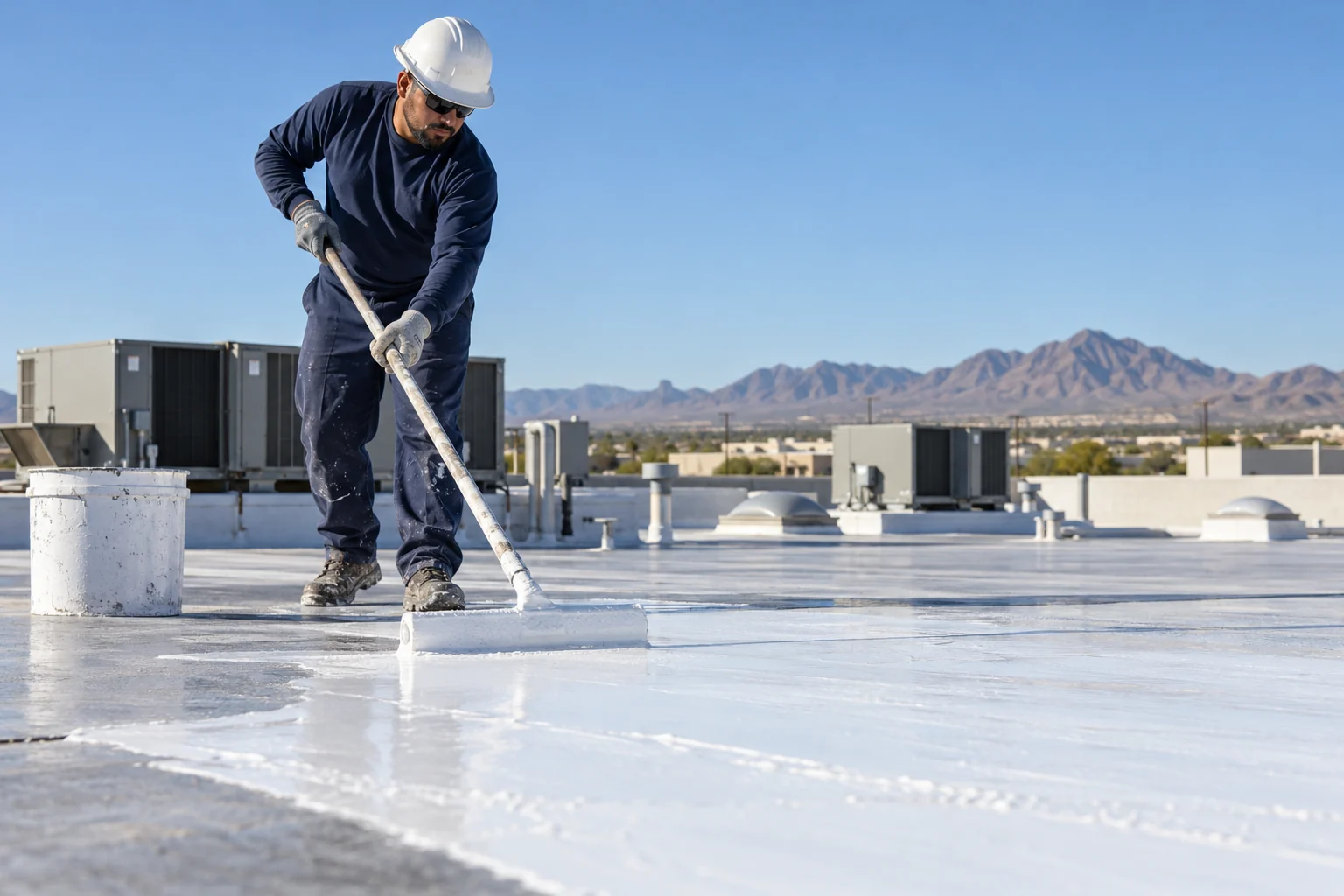
Evaluate Separate Roof Areas
If a building has additions or roof sections completed at different times, their condition may differ. One area may be suitable for restoration while another needs repairs or removal of affected material. The assessment should reflect those differences.
Approximate total area is useful for an initial budget, but it does not establish the same work across every section. Identify the affected portion if your request relates to one area.
Prepare For The Building’s Use
Roof access and material handling should account for entrances, parking and operating activity. Explain those requirements when requesting an estimate. Coating may limit disruption compared with full removal, but the actual work still needs practical coordination.
Commercial Roof Coating Options for Buckeye
Our coating services cover metal roof restoration, silicone systems, acrylic systems and spray foam roofing. A commercial building can contain more than one roof construction, especially where additions or separate wings meet. We consider the existing material in each affected area instead of assuming that one coating specification fits the entire property.
For membrane roofing, the exposed surface and any prior repairs determine what a new coating must bond to. A metal section needs attention to panels and connections. An existing foam area requires evaluation of the protective finish and the foam below. These differences can affect how the work is prepared even when the finished roof has a consistent appearance.
Connect The Roof Sections Correctly
The junction between two roof sections deserves attention in its own right. Changes in material, elevation or movement can make that transition different from the open field on either side. A restoration plan needs to carry the waterproofing through the connection with suitable details; coating each surface separately does not automatically address the joint.
If one section has had repeated repairs, tell us which part of the building is involved. A roof can have serviceable areas alongside localized damage. Defining those boundaries helps distinguish what can remain from what needs correction. It also prevents an initial whole-building area figure from being mistaken for a final treatment plan.
Benefits of Coating Your Roof
Where enough of the assembly remains suitable, restoration can retain roofing that would otherwise be removed in a full replacement. That may reduce tear-off waste and the material handling required around the property. Limited removal does not mean that damaged areas should stay; the benefit comes from preserving sound material while correcting defects.
The project may also involve less disruption and a lower cost than replacement. Both depend on the repair scope, access and chosen system. If the restored roof remains serviceable, another compatible coating may be considered in the future. That option is assessed at the time and is not an automatic renewal promise.
Inspect Your Roof
We begin with the existing roof areas, their connections and any reported leaks. Useful information includes whether the concern affects the whole building, an addition or a particular roof zone. The inspection can then establish whether the surfaces have similar conditions or need separate treatment.
Necessary repairs come before the general coating application. Surface preparation and primers are selected for the actual materials, followed by treatment of seams, penetrations and other details. The application schedule must allow the system to be installed under appropriate conditions. Review of the completed work includes transitions between the different areas, not just the appearance of the open surface.
Questions From Commercial Property Owners
Can only part of a roof be coated? A defined section may be considered where its boundaries and connections allow suitable work. The adjacent roof still matters. The end of the new system must connect correctly to what remains, and a problem in another section should not be mistaken for failure of the treated area.
Does a large roof automatically make coating the best choice? Size influences an area-based budget, but it does not establish condition. A smaller roof with a sound base may be a better restoration candidate than a much larger roof with extensive moisture or attachment problems.
Can daily operations continue? The work may be coordinated around an occupied commercial property, but the necessary restrictions depend on access, preparation and application. Discuss loading areas, entrances and any sensitive operations early. We do not promise that every project can proceed without interruption.
Request A Buckeye Coating Assessment
Our coverage focuses on Buckeye’s developed commercial areas. Enter the property address so the building and work location can be identified correctly. Do not rely on a broad neighborhood description when several buildings are involved.
Use the roof calculator for a preliminary range, then discuss which roof sections the area includes. Its fixed rates do not account for hidden damage, unusual transitions or every access requirement. An inspection is needed to establish the actual restoration scope and determine whether repairs or replacement work are more appropriate in any area.